


miniaturearmor
M1866 Yatagan Bayonet with Scabbard – 22 cm Alloy Miniature - MA HERITAGE
M1866 Yatagan Bayonet with Scabbard – 22 cm Alloy Miniature - MA HERITAGE
Couldn't load pickup availability
Specifications
- Overall length: 22 cm / 8.66 inches
- Weight: approx. 72 g / 2.54 oz
- Guard: Steel-tone, forward quillon with ball finial
- Grip: Ribbed brass-tone alloy, machined slots
- Scabbard: Metal, steel-grey finish
- Edge: Alloy casting, not steel. The profile is accurate and the surface is finished by hand, but this is a display replica — it is not ground for cutting and is not meant to be.
- Assembly: Fittings, guard and grip are separate cast and machined parts, assembled rather than moulded as a single piece.
- Use: Display, diorama and close-up photography — a study model of the pattern, not a cutting tool
- Model: M1866 Yatagan – 22 cm / 8.66 inches
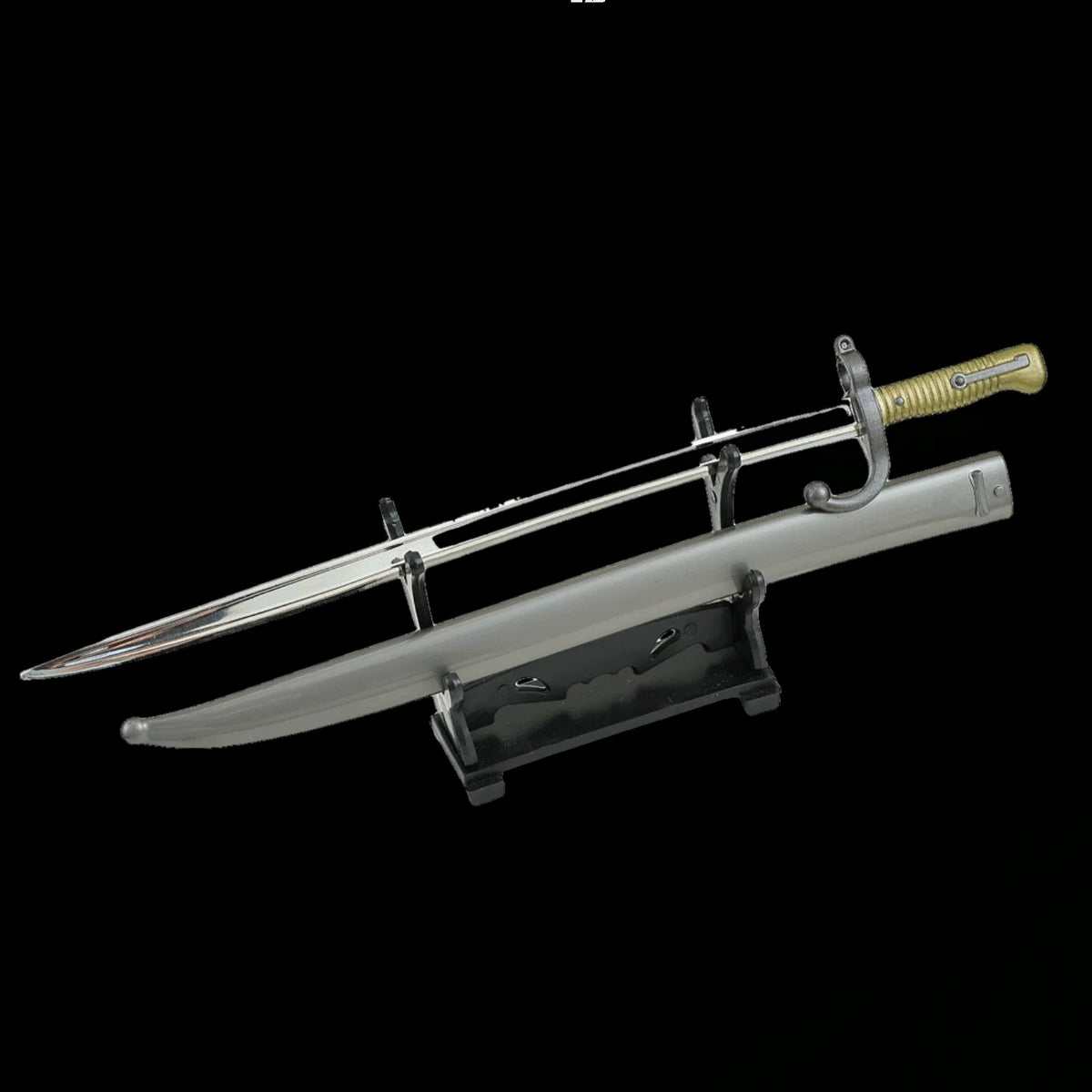
M1866 Yatagan Bayonet — France's M1866 yatagan bayonet, reduced to a 22 cm (8.66 inches) display piece with its scabbard.
The yatagan bayonet is a compromise that did not last, and the reason it did not last is the most interesting thing about it. Mid-nineteenth-century armies wanted a bayonet that could cut as well as thrust, so they borrowed the curved yatagan blade from the Ottoman world — a shape designed for a draw cut. It worked, and it was replaced within a generation by the slim spike, because a bayonet's real job turned out to be stabbing a man in a trench rather than fencing with him.
The quillon with its ball finial is the detail that dates the piece precisely. A forward quillon on a bayonet is a blade-catcher — it exists for the parry in a bayonet duel, a form of fighting that armies trained for and almost never used. That finial is a record of an expectation that did not survive the century.
The ribbed brass grip with machined slots is the other period marker. It is a mass-produced part made on a machine that had just been invented, and it sits next to a blade shape inherited from hand craft. An object caught between two industrial eras is always more legible than one that belongs cleanly to either.
A Display Piece, by Design
Not every piece in the range is built to cut, and pretending otherwise would be the easiest way to lose a customer. This one is an alloy casting: the profile, the quillon, the ribbed grip and the scabbard are all reproduced accurately, and none of it is meant to take an edge or a blow.
What it is good for is the thing a photograph cannot do — holding the object at the size the pattern was drawn at, turning it over, and seeing how the blade-catcher sits against the guard and why the grip is slotted the way it is. Keep it dry, dust it with a soft brush, and it will outlast the paper it is printed on.
Researched, Not Guessed
Hong Kong Miniature Armor Co. Ltd. is a studio of historical researchers and artisan sculptors, not a reseller. The piece follows the French M1866 yatagan bayonet in its issued form — single-edged curved blade with a full-length fuller, forward quillon with a ball finial, ribbed brass-tone grip with machined slots, and a steel-grey scabbard. It is built to measured dimensions: 22 cm (8.66 inches) overall, about 72 g (2.54 oz), with the fuller running the length of the blade as on the original.
True to Scale in Every Proportion
Reduced to 22 cm (8.66 inches) with the bayonet's proportions intact: the curve of the yatagan against the blade length, the quillon length against the guard, the grip diameter against a hand. A yatagan blade on the wrong curve reads as a kitchen knife, so the sweep is the first thing that had to be right, and the fuller the second.
Craftsmanship
- Structural and surface precision — a single-edged yatagan blade with a full-length fuller, a forward quillon with a modelled ball finial, and a ribbed grip with machined slots rather than moulded lines
- Material and weight — about 72 g (2.54 oz) in the hand with a brass-tone alloy grip and a steel-tone guard — heavy enough to feel like an issued object rather than a souvenir
- Hand-applied finish — the blade is finished steel-grey with the fuller reading as a darker channel, and the grip is toned so the ribs catch light in a regular rhythm
An Edition of One
Toning a ribbed grip by hand produces a slightly irregular rhythm of highlights, which is exactly how an issued brass part wears — and no two come out the same. Each bayonet is an individual studio edition. It comes with its scabbard, which matters: a bayonet without one is a blade, and with one it is a piece of kit. It is also the best-value object here for what it teaches: a bayonet rather than a sword, so every decision on it was made by a quartermaster rather than a patron, and quartermasters are ruthlessly honest about what works. Look at the grip and the scabbard and you can see an army thinking about cost. That is a rare thing to hold.
A display replica cast in alloy: accurate in profile and finish, and not intended to cut. It is not a weapon and not a tool — display it, photograph it, and keep it out of reach of children.
Own the compromise that lasted one generation — M1866 Yatagan Bayonet, 22 cm (8.66 inches). Add to cart today.


You may also like other collections
-

European Armor & Weapons
Medieval European knight helmets and armor busts - great helms, bascinets and...
-

Japanese Weapons
Miniature Japanese swords - katana, wakizashi, tachi and odachi - with VG10...
-

Chinese Arms & Armor
The complete Chinese arms and armor collection - swords, spears, helmets and...
-

Framed Display Pieces
Wood-framed shadow boxes with Tang and Song arms, scholar's sets and armor...
-

Roman Figures & Weapons
Rome appears here in full figure as well as in steel: legionaries...
-

Beyond the Middle Ages
The medieval tradition did not stop at 1500. This group follows the...
-

Beyond the Dynasties
The pieces that fall outside the dynastic line: a black-and-gold ancient blade,...
-

Spartan Warriors
Spartan kit is unmistakable: a Corinthian helmet with a tall horsehair crest,...
-

German & Gothic Armor
German armorers of the 15th century worked plate into ridges, flutes and...
-

Italian & Milanese Armor
Italian armor is recognized by its smooth, rounded plate, broad shoulders and...


Most popular topics in our community
-

The Same Spear at 1:6 and 1:12: What Halving a ...
A 1:6 brass spear and a 1:12 screw-together spear, side by side: socket walls, the joint you cannot hide, fullers that vanish, the tassel problem and what balance means when...
The Same Spear at 1:6 and 1:12: What Halving a ...
A 1:6 brass spear and a 1:12 screw-together spear, side by side: socket walls, the joint you cannot hide, fullers that vanish, the tassel problem and what balance means when...
-

Phoenix Wing and Dragon Crest: Chinese General'...
Phoenix-wing and dragon-crest helmets are about being read as a general, not about stopping a blow. How the Song-Ming 'wing' and the Qing 'crest' do rank differently, the resin casting...
Phoenix Wing and Dragon Crest: Chinese General'...
Phoenix-wing and dragon-crest helmets are about being read as a general, not about stopping a blow. How the Song-Ming 'wing' and the Qing 'crest' do rank differently, the resin casting...
-

The Sui Ring-Pommel Dao: The Last of the Line
The ring-pommel dao ran from Han to Sui, then the ring disappeared. Not a change in taste — the Central Asian double-lobed suspension mount let the scabbard hang from the...
The Sui Ring-Pommel Dao: The Last of the Line
The ring-pommel dao ran from Han to Sui, then the ring disappeared. Not a change in taste — the Central Asian double-lobed suspension mount let the scabbard hang from the...
-

Shield Bosses: Celtic, Roman and Medieval Solut...
What a shield boss actually does — on Celtic round shields, the Roman scutum and the medieval kite — and why the boss shrank as shields moved from a central...
Shield Bosses: Celtic, Roman and Medieval Solut...
What a shield boss actually does — on Celtic round shields, the Roman scutum and the medieval kite — and why the boss shrank as shields moved from a central...
-

The Four Tang Swords: Yidao, Zhangdao, Hengdao,...
The Tang Six Statutes list four dao — yidao, zhangdao, hengdao and modao. What each was for, why the ceremonial blade is the flashiest, and what the Shōsōin preserved.
The Four Tang Swords: Yidao, Zhangdao, Hengdao,...
The Tang Six Statutes list four dao — yidao, zhangdao, hengdao and modao. What each was for, why the ceremonial blade is the flashiest, and what the Shōsōin preserved.
-

Longquan: The Sword City and the Jian It Makes
Longquan in Zhejiang has forged swords for over two thousand years. What folding actually does to steel, how the trade divides its benches, and how to judge a 1:3 desk...
Longquan: The Sword City and the Jian It Makes
Longquan in Zhejiang has forged swords for over two thousand years. What folding actually does to steel, how the trade divides its benches, and how to judge a 1:3 desk...
-

Reading a Metal Finish: Aged Gold, Rubbed Silve...
How a cast knight figurine gets its aged-gold finish — plating, antique wash, rub-back — why it beats flat paint, and how to keep the effect alive on the shelf.
Reading a Metal Finish: Aged Gold, Rubbed Silve...
How a cast knight figurine gets its aged-gold finish — plating, antique wash, rub-back — why it beats flat paint, and how to keep the effect alive on the shelf.
-

The Biga: Rome's Two-Horse Chariot and the Circus
Biga, quadriga and seiugae; the carceres, spina and metae of the circus; the auriga's whip, waist-wrapped reins and cutting knife; and our antique-bronze two-horse chariot statue in two sizes.
The Biga: Rome's Two-Horse Chariot and the Circus
Biga, quadriga and seiugae; the carceres, spina and metae of the circus; the auriga's whip, waist-wrapped reins and cutting knife; and our antique-bronze two-horse chariot statue in two sizes.
-

The Xiuchun Dao: A Ming Guard's Sabre and Its G...
What the xiuchun dao actually was: the name, the yanling blade profile, why the gilt openwork fittings carried the rank, and how our two 1:6 editions — gilt mounts and...
The Xiuchun Dao: A Ming Guard's Sabre and Its G...
What the xiuchun dao actually was: the name, the yanling blade profile, why the gilt openwork fittings carried the rank, and how our two 1:6 editions — gilt mounts and...
-

Axe Anatomy: Eye, Cheek, Beard and Poll
What the eye, cheek, bit, beard and poll of an axe actually do, how the beard buys cutting length without weight, and how our 1:6 bearded axe answers the same...
Axe Anatomy: Eye, Cheek, Beard and Poll
What the eye, cheek, bit, beard and poll of an axe actually do, how the beard buys cutting length without weight, and how our 1:6 bearded axe answers the same...


