

Miniature Armor
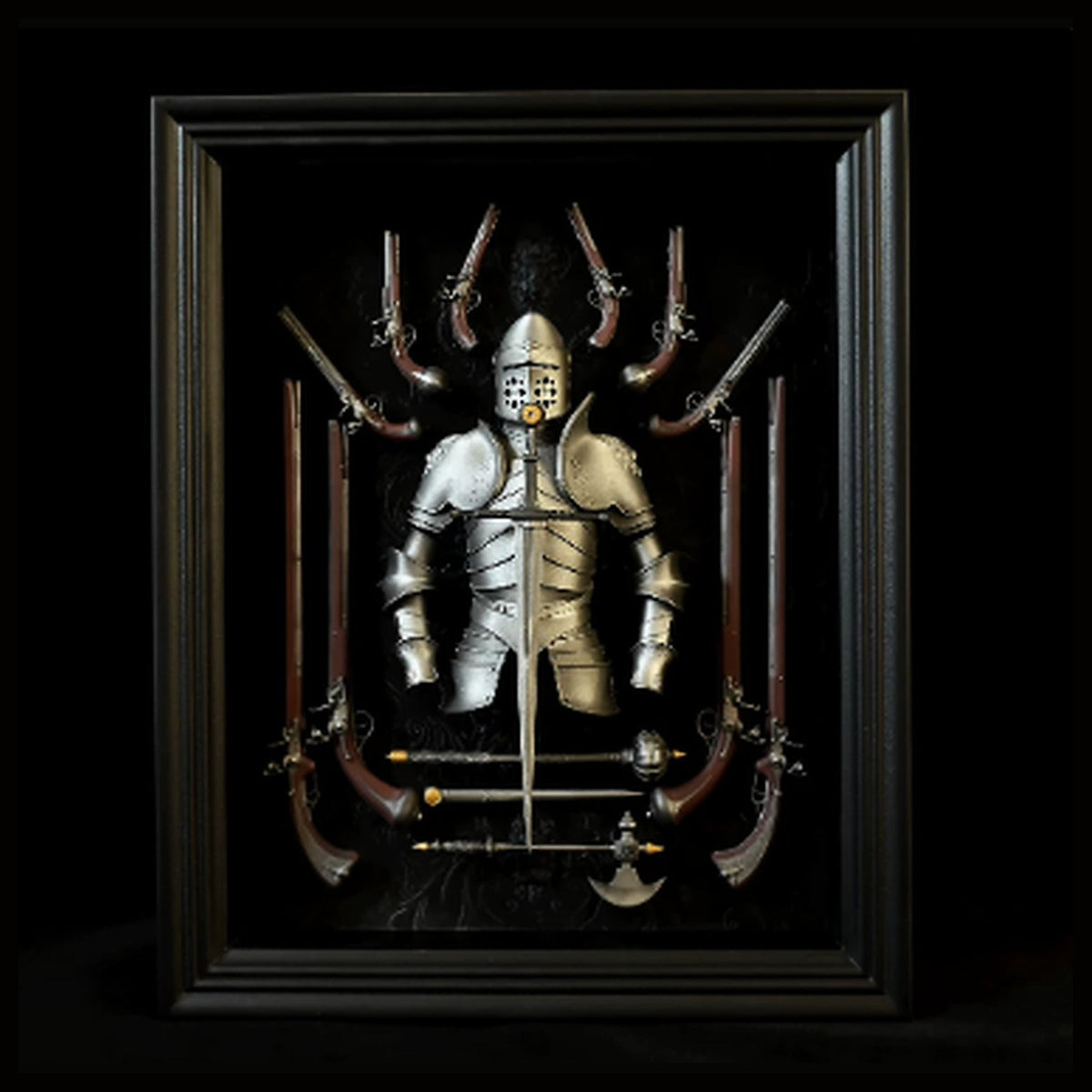
Medieval European Knight & Musket Armor Picture Frame Decor - MA HERITAGE
Medieval European Knight & Musket Armor Picture Frame Decor - MA HERITAGE
Couldn't load pickup availability
Specifications
- Frame material: High-density cold-cast resin
- Style: Late-medieval knight and matchlock relief
- Dimensions: 270 × 220 mm (10.6 × 8.7 in) — sized for standard miniature prints and small photographs
- Weight: approx. 450–550 g
- Glazing: Sized to take standard glazing, museum glass compatible
- Backing: Fold-out easel / rear kickstand
- Reference: LTCP-359
Knight & Musket Frame — plate armour and a matchlock in one border — the exact century the knight stopped being the point.
There is a moment in the sixteenth century that this frame is built around: a man in full harness, still wearing the armour his grandfather died in, being shot off a horse by a farmhand with a smouldering cord and eight ounces of lead. The armour did not fail because it was badly made. It failed because it was made for a different argument. Gunsmiths answered by proofing plate against powder — you can still see the dent where a test ball was fired into a breastplate and the armourer kept it as a certificate.
The relief is cut at two depths for that reason. Armour sits behind; the firearm comes forward. The border is not a jumble of medieval objects, it is a staged transition, and the eye reads it in the correct order without being told.
Researched, Not Guessed
Hong Kong Miniature Armor Co. Ltd. is a studio of historical researchers and artisan sculptors, not a reseller. This piece was developed from surviving harness of the late fifteenth and sixteenth centuries, from matchlock mechanisms in museum collections, and from the armourers own proofing records — the practice of firing a ball into finished plate and stamping or keeping the mark. The serpentine, the trigger guard and the lock plate are modelled as real components with thickness, not as silhouettes laid on a surface, because the mechanism is the historical point of the object.
True to Scale in Every Proportion
Proportions are set for a wall rather than for a shelf: the crests of the helmets against the height of the top rail, the length of the matchlock against the side rail so the barrel does not crowd the corner, the step between the two relief depths chosen so the armour reads as being genuinely behind the gun. Border width against aperture is held at the ratio a print room would use — wide enough to do the work at three paces, tight enough that the picture stays the subject.
Craftsmanship
- Moulding and relief — two distinct carving depths stage armour and firearm as separate layers, and the serpentine, lock plate and trigger guard are modelled with real thickness and a trigger that sits in its own slot
- Material and weight — high-density cold-cast resin, approx. 450–550 g — enough mass to hang flat against a wall or stand steady on its easel without tipping forward
- Hand-applied patina — steel antiqued dark across the harness while the gunmetal is held a shade cooler and bluer, then both rubbed back on the high points so the two metals separate under a single lamp
An Edition of One
Hand finishing two metals to different tones on one casting is the hardest part of the piece and the least repeatable: the harness always takes its shadow slightly differently from the barrel. Every frame therefore leaves the bench with its own aging profile, an edition of one. It is also the most argumentative object in the range — hang it where someone will ask which came first. Hang it where the lamp falls from one side; the two metal tones only separate properly in raking light.
Working photo frame with a fold-out easel back. Cast and hand-antiqued, so the patina on each frame differs slightly.
Hang the end of an era on your wall — armour and the gun that retired it. Add to cart today.

You may also like other collections
-

European Armor & Weapons
Medieval European knight helmets and armor busts - great helms, bascinets and...
-

Japanese Weapons
Miniature Japanese swords - katana, wakizashi, tachi and odachi - with VG10...
-

Chinese Arms & Armor
The complete Chinese arms and armor collection - swords, spears, helmets and...
-

Framed Display Pieces
Wood-framed shadow boxes with Tang and Song arms, scholar's sets and armor...
-

Roman Figures & Weapons
Rome appears here in full figure as well as in steel: legionaries...
-

Beyond the Middle Ages
The medieval tradition did not stop at 1500. This group follows the...
-

Beyond the Dynasties
The pieces that fall outside the dynastic line: a black-and-gold ancient blade,...
-

Spartan Warriors
Spartan kit is unmistakable: a Corinthian helmet with a tall horsehair crest,...
-

German & Gothic Armor
German armorers of the 15th century worked plate into ridges, flutes and...
-

Italian & Milanese Armor
Italian armor is recognized by its smooth, rounded plate, broad shoulders and...


Most popular topics in our community
-

The Same Spear at 1:6 and 1:12: What Halving a ...
A 1:6 brass spear and a 1:12 screw-together spear, side by side: socket walls, the joint you cannot hide, fullers that vanish, the tassel problem and what balance means when...
The Same Spear at 1:6 and 1:12: What Halving a ...
A 1:6 brass spear and a 1:12 screw-together spear, side by side: socket walls, the joint you cannot hide, fullers that vanish, the tassel problem and what balance means when...
-

Phoenix Wing and Dragon Crest: Chinese General'...
Phoenix-wing and dragon-crest helmets are about being read as a general, not about stopping a blow. How the Song-Ming 'wing' and the Qing 'crest' do rank differently, the resin casting...
Phoenix Wing and Dragon Crest: Chinese General'...
Phoenix-wing and dragon-crest helmets are about being read as a general, not about stopping a blow. How the Song-Ming 'wing' and the Qing 'crest' do rank differently, the resin casting...
-

The Sui Ring-Pommel Dao: The Last of the Line
The ring-pommel dao ran from Han to Sui, then the ring disappeared. Not a change in taste — the Central Asian double-lobed suspension mount let the scabbard hang from the...
The Sui Ring-Pommel Dao: The Last of the Line
The ring-pommel dao ran from Han to Sui, then the ring disappeared. Not a change in taste — the Central Asian double-lobed suspension mount let the scabbard hang from the...
-

Shield Bosses: Celtic, Roman and Medieval Solut...
What a shield boss actually does — on Celtic round shields, the Roman scutum and the medieval kite — and why the boss shrank as shields moved from a central...
Shield Bosses: Celtic, Roman and Medieval Solut...
What a shield boss actually does — on Celtic round shields, the Roman scutum and the medieval kite — and why the boss shrank as shields moved from a central...
-

The Four Tang Swords: Yidao, Zhangdao, Hengdao,...
The Tang Six Statutes list four dao — yidao, zhangdao, hengdao and modao. What each was for, why the ceremonial blade is the flashiest, and what the Shōsōin preserved.
The Four Tang Swords: Yidao, Zhangdao, Hengdao,...
The Tang Six Statutes list four dao — yidao, zhangdao, hengdao and modao. What each was for, why the ceremonial blade is the flashiest, and what the Shōsōin preserved.
-

Longquan: The Sword City and the Jian It Makes
Longquan in Zhejiang has forged swords for over two thousand years. What folding actually does to steel, how the trade divides its benches, and how to judge a 1:3 desk...
Longquan: The Sword City and the Jian It Makes
Longquan in Zhejiang has forged swords for over two thousand years. What folding actually does to steel, how the trade divides its benches, and how to judge a 1:3 desk...
-

Reading a Metal Finish: Aged Gold, Rubbed Silve...
How a cast knight figurine gets its aged-gold finish — plating, antique wash, rub-back — why it beats flat paint, and how to keep the effect alive on the shelf.
Reading a Metal Finish: Aged Gold, Rubbed Silve...
How a cast knight figurine gets its aged-gold finish — plating, antique wash, rub-back — why it beats flat paint, and how to keep the effect alive on the shelf.
-

The Biga: Rome's Two-Horse Chariot and the Circus
Biga, quadriga and seiugae; the carceres, spina and metae of the circus; the auriga's whip, waist-wrapped reins and cutting knife; and our antique-bronze two-horse chariot statue in two sizes.
The Biga: Rome's Two-Horse Chariot and the Circus
Biga, quadriga and seiugae; the carceres, spina and metae of the circus; the auriga's whip, waist-wrapped reins and cutting knife; and our antique-bronze two-horse chariot statue in two sizes.
-

The Xiuchun Dao: A Ming Guard's Sabre and Its G...
What the xiuchun dao actually was: the name, the yanling blade profile, why the gilt openwork fittings carried the rank, and how our two 1:6 editions — gilt mounts and...
The Xiuchun Dao: A Ming Guard's Sabre and Its G...
What the xiuchun dao actually was: the name, the yanling blade profile, why the gilt openwork fittings carried the rank, and how our two 1:6 editions — gilt mounts and...
-

Axe Anatomy: Eye, Cheek, Beard and Poll
What the eye, cheek, bit, beard and poll of an axe actually do, how the beard buys cutting length without weight, and how our 1:6 bearded axe answers the same...
Axe Anatomy: Eye, Cheek, Beard and Poll
What the eye, cheek, bit, beard and poll of an axe actually do, how the beard buys cutting length without weight, and how our 1:6 bearded axe answers the same...


